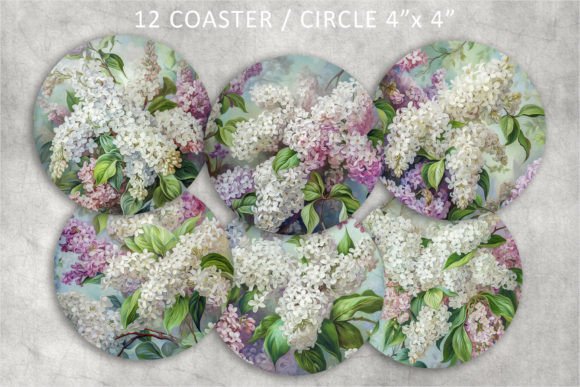
Unpacking the Lilac Color Circle Images Collage Sheet
The Specific Character of this Digital Set
When working with the Lilac Color Circle Images, Collage Sheet, you are dealing with a specific visual language. The collection is defined by its use of the lilac hue—a color that sits between soft violet and dusty pink. This isn't just a single flat color; it involves gradients, textures, and variations across the 12 distinct designs. The "circle" format is a deliberate constraint that creates immediate visual cohesion. Whether used as a display font for a header or as a background element, the shape is versatile. The overall appeal is one of gentle sophistication. It avoids the sharpness of high-contrast sans serif font styles and the formality of a classic serif font, instead offering a modern, approachable aesthetic that feels curated and intentional.
From a practical standpoint, the set is built for production. The files are optimized for real-world application, not just screen viewing. You receive 12 individual PNG files at 300 dpi, sized at 4" x 4" (1200 x 1200 px) with transparent backgrounds. This is critical for clean layering in design software. The inclusion of three JPG files arranged on A4/standard letter-size sheets (8.5" x 11") at high resolution simplifies the printing process for those using home printers or preparing files for a print shop. This isn't abstract modern typography; it's a ready-to-use design asset package.
Strategic Applications in Creative Projects
Understanding where these lilac circles excel is key to leveraging their value. Their primary strength lies in applications where a consistent, thematic color palette and shape are needed. Consider packaging design for a bath and body product line—the lilac tones evoke calm and care, while the circles can serve as labels, seals, or patterned backgrounds. For brand identity work, especially for wellness, beauty, or boutique lifestyle brands, this set can form the visual bedrock. The circles can be used in logo design as a supporting element, in social media graphics as repeated motifs, or in web design as decorative icons or section dividers.
The practical file format makes it exceptionally useful for physical products. The transparent PNGs are ideal for sublimating onto round coasters, a popular niche in the custom product market. They are equally suited for creating custom magnets, greeting cards, and gift tags. For craft projects, the possibilities are extensive: think handmade jewelry pendants, scrapbook embellishments, or custom stationery. The collage sheet JPGs are perfect for those who want to print a variety of designs at once, perhaps for a craft fair inventory or a DIY kit. This set functions as a premium font would in a typographic system—it provides a core, reusable element that ensures visual consistency across multiple outputs.
How the Visuals Influence Perception and Engagement
The lilac color palette has inherent psychological associations. It often conveys creativity, femininity, nostalgia, and tranquility. Using these images strategically can influence how your audience perceives a brand or product. A consistent visual language built with these assets can enhance brand perception as being thoughtful and detail-oriented. In editorial design, such as in a magazine or blog layout, the circles can be used to break up text-heavy pages, creating points of visual interest that guide the reader's eye and improve overall engagement. This is a form of visual hierarchy that doesn't rely solely on font pairing or typographic weight.
However, context is everything. The soft, rounded nature of these circles might not align with a brand that needs to project high energy, urgency, or ruggedness. It's less suited for a sports brand or a financial institution's primary identity, but could work beautifully as a secondary element for a campaign. The key is readability and clarity. When using these as backgrounds for text, ensure sufficient contrast. A lilac circle behind dark grey text can work; behind a similar mid-tone purple will fail. Always test your font pairings against these visual elements. A clean script font or a bold handwritten font might complement the organic feel, while a geometric sans serif could provide a pleasing modern contrast.
Practical Guidance for Evaluation and Use
Before integrating the Lilac Color Circle Images, Collage Sheet into a professional workflow, a few checkpoints are valuable. First, evaluate the project fit. Does the brief call for a soft, decorative, and cohesive visual element? If the answer is yes, this set is a strong candidate. Second, consider the technical requirements. The 300 dpi resolution and specific pixel dimensions are ideal for most print and digital applications, but for very large format printing (like banners), you may need to check if the resolution holds. The transparent backgrounds in the PNGs are a major advantage, allowing for seamless integration into complex designs.
Treat this set as you would any other creative font or design asset. Import the files into your preferred software—whether it's Adobe Photoshop, Illustrator, Canva, or Procreate—and experiment. Try scaling them, rotating them, combining them with other textures, or using them as clipping masks. The JPG collage sheets are excellent for quick mockups or for sourcing individual circles via selection tools. For entrepreneurs and small business owners creating their own marketing materials, this set offers a shortcut to a polished, professional look without the need for advanced design skills. It provides a ready-made solution for creating consistent commercial products like coasters, magnets, and tags that can be sold on platforms like Etsy or at local markets.
Ultimately, the value of this collection lies in its specificity and production-readiness. It’s not a generic set of shapes; it’s a focused toolkit built around a particular color and form. Used thoughtfully, it can become a foundational element in a brand identity, a standout feature in packaging design, or the core of a successful product line. The key is to move beyond seeing it as mere decoration and to understand it as a strategic component of your visual communication, one that carries its own personality and can significantly shape the audience's experience with your work.